Lifetime Support Authority
2023–24 Annual Report
To: The Hon Stephen Mullighan MP
Treasurer
This annual report will be presented to Parliament to meet the statutory reporting requirements of the Motor Vehicle Accidents (Lifetime Support Scheme) Act 2013 and the requirements of Premier and Cabinet Circular PC013 Annual Reporting.
This report is verified to be accurate for the purposes of annual reporting to the Parliament of South Australia.
Submitted on behalf of the LIFETIME SUPPORT AUTHORITY by:
- Andrew Culley, Chair, Lifetime Support Authority Board
- Rick Howe, Chief Executive, Lifetime Support Authority
From the Chief Executive and Board Chair
We are pleased to present the annual report for the Lifetime Support Authority (LSA)
for the financial year ended 30 June 2025. Details of the LSA’s activities and
achievements for the year are provided within this report, highlighting how the
organisation has delivered on its core purpose to plan and fund lifelong treatment, care
and support to individuals affected by very serious injuries from motor vehicle
accidents on South Australian roads.
Performance highlights
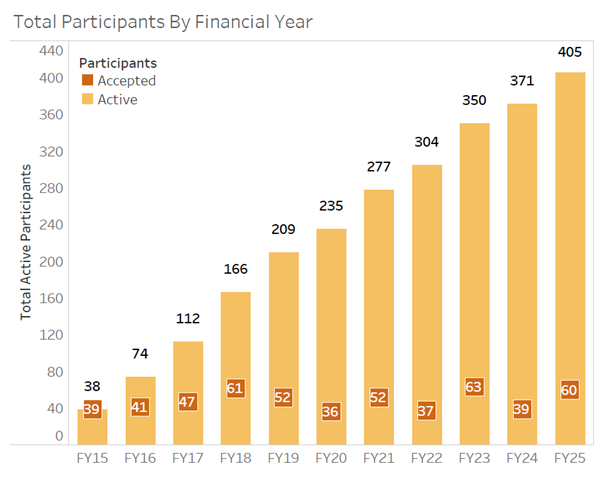
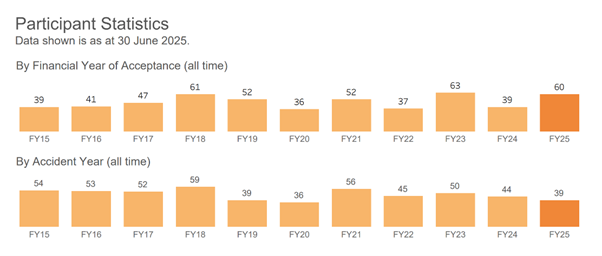
During the year, the LSA accepted 60 new participants into the Lifetime Support
Scheme (LSS). Offsetting the newly accepted participants, 17 existing participants
exited the Scheme as a result of their injuries recovering to an extent that they no
longer qualify for the support of the Scheme. A further 9 participants passed away
during the year. This meant there were 405 active participants in the Scheme as at 30
June 2025, up from 371 at the end of the last financial year.
The number of new participants accepted into the Scheme was higher than average,
but still well within expected statistical norms. Given the larger than expected number
of exits from the Scheme, the net increase in active participants of 34 was lower than
originally projected.
This meant that the financial position for the Scheme was much better than budgeted,
driven by a smaller than expected increase in liabilities and strong investment income
increasing our underlying asset base.
The full year result was a profit of $150.5 million, against an expected loss of $26.9
million. Revenue was $390 million, of which $222 million was from LSS Levy
payments and the remainder ($168 million) was primarily investment returns.
Expenses were all under budget, including current year treatment, care and support
(TCS) costs, employee expenses, administration costs and most significantly, the
provision for outstanding future liabilities.
In total, expenses were $239.5 million against a budget of $382 million, with $116
million of the savings derived from the better than expected valuation of future
liabilities.
When this result is included in the balance sheet, the accounting funding ratio has
risen to 101% from 93% last year, with total assets of $2.00 billion and outstanding
liabilities totalling $1.97 billion.
The achievement of a funding ratio above 100% has been delivered a number of years
earlier than anticipated. Whilst this is excellent news in terms of the Scheme’s current
sustainability, the volatility around both our liability valuation and investment returns
means that this can quickly fall back below 100% in the future. We will be keeping a
careful eye on external influences on these, in particular mortality experience and
potential increases in cost and utilisation of attendant care in future.
Strategic Plans and KPIs
The LSA continued to implement its 4-year Strategic Plan which commenced in 2022.
The main focus has been on how to best leverage the newly implemented technology
platform, SALSA2, to improve service quality for participants, along with determining
how best to scale up our service delivery teams to cater for anticipated Scheme growth
in the coming years. Two key strategic projects have now been approved by the Board
to deliver significant changes over the next two years to both the front line team
processes and procedures, and the IT platform supporting them. This will provide for
greater automation of routine administrative processes, and hence provide more
opportunities for participant facing interaction, with the objective of improving
participant independence and autonomy in the future.
During 2024-25, the LSA progressed several strategic initiatives aligned to its 2022-
2026 Strategic Plan. These included improvements to how internal change is
managed, the way data informs decision-making, and how projects and services are
delivered across the organisation. Notably, the implementation of the Atlassian suite
of software products has modernised internal workflows and documentation, while the
integration of a Change Management Framework has enhanced the consistency and
effectiveness of organisational change.
Further focus was placed on workforce capability and stakeholder engagement.
Enhancements to the MyCareer platform supported more efficient recruitment and
onboarding, and the rollout of the updated Stakeholder Engagement Framework
provided greater clarity around how and when the organisation engages with its key
partners. Together, these initiatives have laid important groundwork for the success of
future work under the newly approved strategic projects.
KPI performance remained strong across key measures as outlined further in this
report, with participant satisfaction, staff engagement, and delivery of research
milestones all meeting or exceeding targets. The Scheme’s financial indicators also
remained within or above benchmark levels, reflecting strong stewardship and
operational discipline.
Operational Activity
In line with the growth of participant numbers in the Scheme, the LSA service planning
workforce has also expanded. Consequently, our total active staff numbers have now
reached just over 100 FTE at the close of the financial year.
Engagement across the workforce has also risen over the year, with the engagement
score in June reaching 76 (against a minimum target of 70).
Our participants provided feedback via the annual Participant Satisfaction Survey, with
the overall satisfaction level remaining steady at 81% (above our target of 80%) and
86% of participants confirming that the LSA is making a positive difference in their
lives. We also welcomed client feedback from stakeholders at the various forums for
participants and service providers run by the LSA during the year.
From a road safety perspective, the LSA is pleased to be involved in assisting with
funding the RAA Street Smart High program, which endeavours to ensure young
drivers have a greater appreciation of the responsibilities which go with driving on our
roads.
The LSA’s Research, Education and Programs (REP) grant program progressed
during the year. In 2024-25, 13 new grants were allocated in addition to ongoing
projects, taking the total of active grants to 30 at the end of the financial year. In
September, the LSA Innovate forum showcased the outcomes from three recently
completed projects to an audience of relevant researchers, health care professionals
and other key stakeholders, with very positive feedback. The forum will be held again
this year with a further three successful research projects being showcased.
Board Appointments
The Treasurer re-appointed David Russell, Kevin Cantley and Linda Matthews to the
Board for a further three-year term during the year.
- Rick Howe, Chief Executive, Lifetime Support Authority
- Andrew Culley, Board Chair, Lifetime Support Authority
Overview: about the agency
Our Purpose
We plan and fund person-centred treatment, care and support services to make a positive difference to participants’ recovery and independence.
Our Vision
Making a difference in the lives of Lifetime Support Scheme Participants, who are at the centre of what we do.
Our Values
At the LSA, our values are brought to life each day by our committed and passionate staff:
People and Passion:
- Our dedicated team offer valuable skills and a like-minded community, always working to better the lives of others.
- Passion fuels our motivation, and with a true sense of purpose and solidarity, we work towards our shared long-term vision. Together we’re committed to building authentic relationships with each other, participants, their families and carers.
Innovation and Growth
- Inspired by the courage and determination shown by participants and their families, we’re continuously searching for new ways to make a greater difference.
- Always learning, it’s with our innovative mindset and curious nature we ask; if not, why not?
- Encouraging growth, we empower those around us with knowledge and resources to overcome obstacles and reach new goals – so together we can look to the future with enthusiasm and optimism.
Trust and Respect:
- At the LSA we’re accountable and lead by example. We understand trust is earned when actions meet words, so our colleagues, participants and their families can always expect honest, open communication and a genuine sense of care.
- We build mutual respect by treating everyone with dignity and kindness.
Our functions, objectives and deliverables
Through the Scheme, the LSA plans and funds necessary and reasonable treatment, care and support for people who sustain serious injuries in a motor vehicle accident on South Australian roads, regardless of fault. Approximately 50 new participants on average have been accepted into the LSS each year, although over the past financial year there have been more participants accepted than predicted.
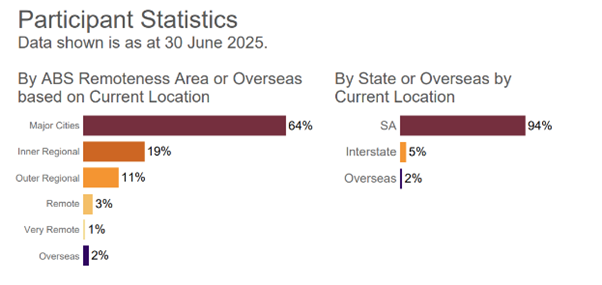
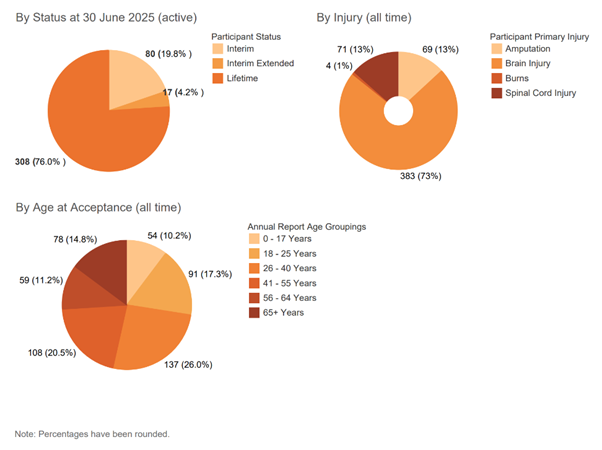
Serious injuries including brain and spinal cord injuries, amputations, burns and blindness can require a lifetime of support to help people engage in rehabilitation and maximise their independence in the community. Approximately 70% of participants have traumatic brain injuries due to a motor vehicle accident. Importantly, the LSS supports the state to deliver on the National Injury Insurance Scheme (NIIS), which operates in conjunction with the Commonwealth’s National Disability Insurance Scheme (NDIS). We deliver services and support in accordance with five strategic themes: 1. Person-centred treatment, care and support for participants 2. Staff and systems which make a positive difference for participants 3. A sustainable Scheme for current and future participants 4. Strong and productive relationships with key stakeholders and service providers, to benefit participants and the Scheme 5. Research, education and programs that ultimately aim to make a positive difference for participants and the Scheme. LSA’s Participant Reference Group - comprised of participants and their families/carers - offers unique, experience driven insights that influence the delivery of our services. Our participants range in age from newborn babies to 90+ years old and live in metropolitan, regional, interstate and in a small number of cases international locations.
The chart below reflects the LSA’s organisational structure as at 30 June 2025.
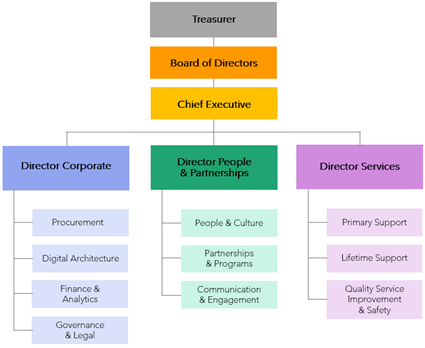
Lifetime Support Authority Organisational Structure
The LSA is governed by the LSA Board with three subcommittees – the Audit Committee, the Rules & Organisational Performance Committee and the Finance & Investment Committee.
During 2024-25, the Board members were:
- Kevin Cantley PSM (Board Member and Chair of the Audit Committee)
- David Russell (Board Member)
- Linda Matthews (Board Member and Chair of the Rules & Organisational Performance Committee)
- Talia Begley (Board Member)
- Nicole Sykes (Board Member)
- Sian Goodson (Board Member)
- Tim Binks (Board Member and Chair of the Finance & Investment Committee)
- Andrew Culley (Chair of the Board)
During 2024-25 the agency implemented the following changes to its structure and objectives.
Corporate Directorate Restructure
During the reporting period, a comprehensive review of the Corporate Directorate was completed to address key operational requirements and strategic objectives.
The restructure successfully repositioned the Corporate Directorate to better support the organisation's technology transformation initiatives while strengthening financial support capabilities. The changes provided improved clarity and alignment across functions, enabling enhanced stakeholder engagement and service delivery.
People and Partnerships Directorate Restructure
Following an operational review and consultation period, the People and Partnerships Directorate underwent a comprehensive restructure during the reporting period.
The restructure established a more holistic people function encompassing employee engagement, competencies, performance management, and career development. Through the integration of Learning & Development and HR functions, the organisation developed a comprehensive approach to workforce and organisational development, while strengthening recruitment and retention capabilities across the LSA.
Our Minister is the Treasurer, which for financial year 2025 was the Hon Stephen Mullighan MP.

The Executive Team during the reporting period consisted of:
Position | Responsibilities |
Chief Executive | Rick Howe is the Chief Executive, who leads the LSA. |
Director Services | Kylie Smith is the Director Services, responsible for overseeing the LSA’s core operations that support LSS participants, including service planning, specialist technical services, as well as quality and safety. |
Director Corporate | Boris Petrovic is the Director Corporate, responsible for overseeing finance, procurement, legal, governance and risk, and information technology functions. |
Director People & Partnerships | Mandy Turnbull is the Director People and Partnerships, responsible for overseeing human resources, work health and safety, people systems, culture and capability, as well as communication and engagement functions and research, education and programs. |
Mandy Turnbull joined the LSA on 8 July 2024 as Director People and Partnerships.
- Department of Treasury and Finance
- CTP (Compulsory Third Party) Insurance Regulator
- South Australian Government Financing Authority (SAFA)
- Super SA
- Funds SA
- HomeStart
- Office of the Industry Advocate
The agency's performance
Since the Scheme commenced, 527 participants have been accepted into the Scheme as at 30 June 2025. Due to injuries no longer being eligible, transferring to other schemes or death, 122 participants were no longer in the Scheme as at 30 June 2025.
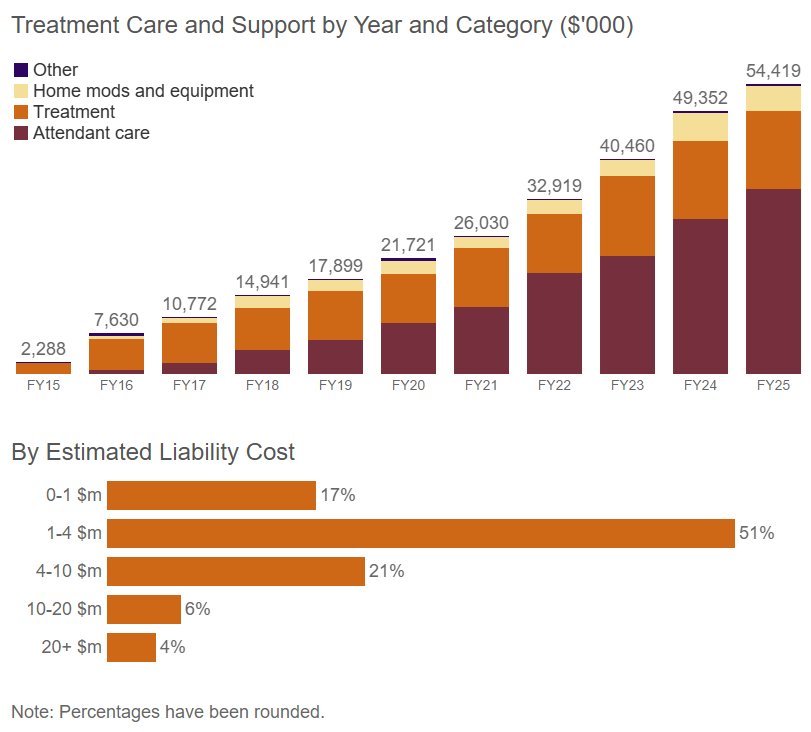
The LSA funds treatment, care and support services for LSS participants. LSS Levies collected each year are intended to fully fund the estimated lifetime costs for new participants who have accidents in the relevant year and meet the eligibility criteria for acceptance into the Scheme.
LSS Levy collections during 2024-25 were $222.1 million (compared to $209.3 million in 2023-24) which is mainly related to an increase in the number of registered vehicles and the LSS Fund Levy rate increasing. The average annual LSS Levy paid by motor vehicle owners, $136.01, increased by 3.4% compared to 2023-24. Currently, only a small part of the LSS Levy is required to fund current Scheme costs and LSA’s operating costs, with the balance required to meet the future liabilities associated with current participants. These unspent funds are invested in a diversified high growth investment portfolio until they are required.
The LSA invests with Funds SA, the South Australian Government owned corporation which invests and manages funds of approved authorities. Financial assets of the LSA have grown to $1,985.1 million as at 30 June 2025 primarily as a result of LSS Fund Levy contributions being invested. The nominal investment return for the LSA investment fund was 9.5%, resulting in a $167.4 million return on investments for the year ending 30 June 2025. The LSA’s investments assets will be used to fund treatment, care and support for all current LSS participants over the next several decades.
The total payments for treatment, care, and support services in 2024-25 amounted to $54.4 million (compared to $49.4 million in 2023-24). The types of treatment, care and support funded are shown in the table below.
| 2024-25 | 2023-24 | ||
| $’000s | % | $’000s | % |
Attendant Care and Support | 34,721 | 63.8 | 29,094 | 58.9 |
Hospital | 5,566 | 10.2 | 6,275 | 12.7 |
Rehabilitation | 7,632 | 14.0 | 6,629 | 13.4 |
Equipment | 3,308 | 6.1 | 3,677 | 7.5 |
Medical Treatment Services | 1,466 | 2.7 | 1,722 | 3.5 |
Home and Vehicle Mods | 1,454 | 2.7 | 1,727 | 3.5 |
Other | 272 | 0.5 | 229 | 0.5 |
TOTAL | 54,419 |
| 49,353 |
|
In addition to the above expenses, a further $139.0 million has been added to the provisions in relation to future treatment, care and support costs compared to last year. The increase compared to last year is mostly related to accidents which occurred during 2024-25 which added $253.1 million in new provisions. This was offset by favourable changes to actuarial assumptions as well as scheme experience which decreased the expected cost of participants included in the valuation by $102.6 million and changes to the economic assumptions (i.e. risk-free discount rate) which resulted in a $11.5 million reduction to the total provision for future treatment, care and support costs.
The LSS is growing, and it is expected that approximately 50 new participants will enter the Scheme each year for the next several decades. As such, the increase in total costs compared to last year is expected and is within the amount modelled by the independent actuary.
The LSA sets Key Performance Indicators which are contained in the 2022–26 Strategic Plan. These are used for the purpose of reporting on LSA’s performance to the Board and the responsible Minister as required by LSA’s Charter.
Agency objectives | Indicators (Target) | Performance |
Participant survey – experience | ≥80% | In 2024, 29% of eligible LSS participants and decision makers completed the Participant Survey.
|
Current MyPlan in place for active participants | 100% | The 100% target for a current MyPlan was achieved. |
Staff engagement - Teamgage | ≥70% | Staff engagement averaged 75% in the year (as reported via Teamgage) which is above the target of 70%. |
Performance measurement – bi-annual reviews | 100% | The LSA continues to meet the KPI relating to staff performance reviews. In both Performance & Development Conversations (September & March) 100% of eligible staff completed their review. The last round of six-monthly performance reviews was completed throughout March 2025. |
Research Education and Programs – delivery of contractual milestones | ≥80% | 100% of the contractual milestones were achieved within the FY24-25, 63.5% were achieved on or before the due date |
Funding Ratio | 80-120% | The accounting funding ratio for the scheme is 101% (up from 93% as at June 2024) and remains within the Board’s target range of 80% to 120%. |
Investment returns since inception | ≥6.25% | The investment return since inception for the Funds SA LSS Strategy is 7.4%, which is 1.15% above the long-term investment return target of 6.25%. |
Net expense ratio | ≤12.5% | Net expense ratio is 9.7% year to date, compared to a target of 12.5%. This is primarily due to service delivery expenses being below budget as well as favourable LSS Levy revenue experience. |
Costs managed against budget | Favourable variance | Operating expenses (excluding treatment, care and support) are favourable compared to budget by $2.2 million for the year. This is primarily due to a favourable budget to actual position for service delivery expenses. |
Key corporate initiatives in 2024-25 included:
Enhancement of Service Delivery Model – Living Life
Building on the development and implementation of the new Living Life service delivery model in 2023/24 in line with strategic theme #1 (person-centred treatment, care and support for participants) the Living Life model was evaluated and continuous improvement initiatives commenced. Further enhancements to the model are planned for 2025/26.
LSA Elevate
To support strategic theme #3 (a sustainable Scheme for current and future participants) significant planning was undertaken to embark on a program of work designed to holistically enhance the service delivery model to ensure it is sustainable as the LSS continues to grow into the future. This program of work is known as LSA Elevate. Sub projects under LSA Elevate will continue over the next 2 years.
SALSA2 Roadmap Project
SALSA2 is the program name for the Salesforce-based Customer Relationship Management platform used by the Lifetime Support Authority (LSA). The SALSA2 Roadmap Project is a strategic initiative aiming to enhance the platform. A clear, implementation plan was developed to guide the future delivery of the project, leveraging our IT platform to automate and simplify administration procedures. This work provided the organisation with greater confidence and clarity around the investment, sequencing, and dependencies required to modernise its core platform. By partnering with an external vendor to shape this approach, the LSA will strengthen its ability to deliver a sustainable and scalable digital environment that supports improved decision-making, increased automation, and better outcomes for staff and participants. This initiative also lays the foundation for future enhancements to be delivered in a more structured, prioritised, and cost-effective manner.
Project and Service Management Platform Implementation
The implementation of the Atlassian suite of software products has significantly modernised how the organisation manages internal service delivery, project work, and operational documentation. Replacing a limited ITSM tool with JIRA Service Management that enables automated workflows for key business processes - such as Conflict of Interest submissions and procurement requests - while giving teams real-time visibility of service volumes, response times, and performance trends. The introduction of JIRA for software delivery has also improved the planning and tracking of SALSA2 platform enhancements, while Confluence now provides a centralised space for documenting projects, procedures, and team knowledge. This implementation has improved transparency, accountability, and efficiency across multiple business functions and has also supported the consolidation of legacy systems, reducing complexity and licensing costs.
Change Management Framework Integration
To improve the way change is managed across the organisation, a Change Management Framework was developed and embedded into the existing Project Management Framework. Built on PROSCI methodology, the new framework introduces practical guidance, templates, and checklists that support a more consistent and people-focused approach to change. This work has increased the organisation’s ability to implement change in a way that considers staff experience, adoption challenges, and long-term benefits realisation - ultimately lifting internal capability and strengthening project outcomes across the LSA.
Data-Driven Decision Making Initiative
A suite of operational and strategic dashboards were developed to support improved decision-making across the organisation. These dashboards provide staff and leaders with access to timely, relevant data to inform day-to-day operations, manage workloads, and monitor scheme performance. The initiative has embedded greater visibility and accountability into core business processes and strengthened the organisation’s ability to make informed decisions using real-time insights.
Risk Culture Survey
A risk culture survey facilitated by an external provider was conducted to provide the LSA with survey outputs that could be used to compare and analyse against the results of a previous risk culture survey conducted in 2022. The survey was developed using similar questions asked of staff in 2022. The survey results across the four core risk culture categories (Strategy and Leadership, Accountability and Reinforcement, Risk Management and Infrastructure, and Capability and Communication) showed an overall decrease in the average favourable percentage scores when compared to the 2022 results. In response, Management developed an action plan and communication plan to address the issues raised.
Compliance & Audit Program
Two initiatives were aimed at maintaining a strong focus on the LSA’s compliance and audit activities. The LSA developed and presented to the Audit Committee a risk and controls assurance map for enterprise risks, aimed at providing an informed assessment of the assurance activity over the LSA’s key risk controls environment and accurately identifying controls assurance gaps. A review was also conducted to assess implementation of audit recommendations, with a goal to decreasing repeat findings, risk control issues and duplication of time to remediate identified findings. The review identified some audit recommendations which had not been implemented effectively and these were addressed.
Stakeholder Assessment and Identification
The implementation of the Stakeholder Engagement Framework informs the LSA’s approach to fostering collaboration and engagement with key stakeholders to build productive relationships to create sustainable and successful initiatives. The Stakeholder Map serves as a strategic tool to identify and categorise LSA stakeholders based on their alignment with and influence over operations. The Stakeholder Map drives the level of engagement for each stakeholder group, facilitating targeted and effective communication strategies.
MyCareer Implementation – Recruitment and Learning & Development Modules
In 2024–25, the LSA successfully implemented the Recruitment & Onboarding module and overhauled the Induction function of the Learning & Development module within the MyCareer platform. These modules build on the Learning & Development functionality introduced the previous year and further strengthen the organisation’s capacity to mange the attraction, development, and retention of talent.
The Recruitment module has streamlined end-to-end hiring processes, improving transparency, efficiency, and candidate experience. The Learning & Development module now provides an online Induction within myCareer, moving away from the previous paper-based process.
Together, these implementations represent a significant step forward in modernising workforce management, supporting a consistent employee lifecycle, and enabling more strategic talent development across the organisation.
Key performance and development programs and initiatives in 2024-25 included:
Professional Development
- Business partnering meetings across the LSA ensure Learning & Development continue to provide expert guidance and assistance in the planning and delivery of professional development opportunities to individuals and teams.
- The LSA has a Professional Development Policy, Procedure and Guidelines to support staff with professional development opportunities and study assistance. Working collaboratively with the Services Directorate, the L&D team plan and deliver an annual calendar of monthly professional development sessions for the Service Planning team. Focused on enhancing role specific knowledge and capabilities of Services staff, these sessions ensure front line staff continue to provide quality person-centred care to LSS Participants.
Learning Management System & Reporting
- Learning & Development expanded the use of the functionality in the LSA’s Learning Management System, myCareer. LSA induction programs are now being issued and managed within the system, rather than paper based, resulting in increased manager visibility, tracking and automation.
- Working with the Business Intelligence and Finance teams, Learning & Development now provides regular reports to Executive, Board and Committees detailing Professional Development spend for each team and directorate. Reports detailing the current FY Professional Development spend for each team is now also provided to managers prior to Performance & Development Conversations. This ensures managers have oversight and awareness of what professional development their team and individual staff members have undertaken since the last P&D Conversation and can enhance and guide conversation relating to new or existing development objectives.
Leadership Development
- Soji Learning PTY LTD delivered the 2024 Leadership Program with 7 learners completing the last program in July 2024. In May 2025, learners from the 2023 Leadership Program were offered the opportunity to retake their LSI diagnostic and have debrief and coaching sessions.
- Learning & Development meet with new leaders (following recruitment or internal staff movements) to inform them about the leadership and management programs that are available to develop or enhance their leadership skills, capabilities or to strengthen strategic thinking. A variety of programs are available and are aligned, depending on the individual’s interest and current leadership experience and skills.
- The LSA promotes and utilises leadership and management programs delivered by the South Australian Leadership Academy (OCPSE), ensuring consistency across leaders at the LSA, as well as the Public Sector. Other external providers are also utilised to deliver leadership and management related programs, workshops or coaching.
Organisational Development
The following programs were delivered in line with LSA strategic objectives and operational requirements:
- LSA Leadership Program - A customised LSA leadership program for new and emerging leaders
- Leader as Coach Program - Designed to assist leaders to become coaches in the workplace to bring out the best in their staff.
- Persuasive Writing - Covers how to write effectively and influence by presenting clear and concise recommendations and reasoning, applying logic, mapping content and using effective and practical language
- Strategies to Manage Time & Workload - Designed to assist individuals in taking control of their workload and develop strategies to improve decision making, prioritisation and time management.
Performance & Development Conversations
- 100% of LSA staff completed biannual performance and development conversations in the myCareer platform.
Program name | Performance |
|---|---|
Employee Assistance Program (EAP) | LSA employees are provided with access to an independent and free counselling service through the Employee Assistance Program. LSA employees have two EAP providers to choose from. |
Mental Health First Aid | LSA had ten trained Mental Health First Aiders, as of 30 June 2025. All employees are eligible to nominate for this training. |
Wellbeing for Our People Program (DTF) | LSA employees have access to a range of DTF work health and safety, and wellbeing initiatives including the Wellbeing for Our People Program. Program initiatives include flu vaccinations, psychological and physical health, workplace support, engagement and connection. The LSA offers wellbeing initiatives such as Corporate Cup, morning teas and other networking activities to improve connection and wellbeing. |
MyErgo and Ergonomic Officers | The LSA has continued to enhance the availability of innovative ergonomic programs. A dedicated platform has been introduced by DTF to proactively manage the risk of workstation-related ergonomic injuries. Additionally, the LSA has appointed and trained designated Ergonomic Officers to support their colleagues and promote improved workstation ergonomics across the LSA. |
Work Health, Safety, and Injury Management | The LSA prioritises Work Health and Safety (WHS) and Injury Management education to ensure staff can perform their duties safely. Comprehensive induction processes are in place for all work groups, including a checklist of mandatory WHS training covering obligations, policies, procedures, site orientation, and workplace safety requirements. The following training programs are either mandated or offered to employees:
|
|---|
Workplace injury claims | 2023-2024 | 2024-25 | % Change |
|---|---|---|---|
Total new workplace injury claims | 1 | 1 | 0% |
Fatalities | 0 | 0 | N/A |
Seriously injured workers* | 0 | 0 | N/A |
Significant injuries (where lost time exceeds a working week, expressed as frequency rate per 1000 FTE) | 0 | 0 | N/A |
*number of claimants assessed during the reporting period as having a whole person impairment of 30% or more under the Return to Work Act 2014 (Part 2 Division 5)
Work health and safety regulations | 2023-24 | 2024-25 | % Change |
|---|---|---|---|
Number of notifiable incidents (Work Health and Safety Act 2012, Part 3) | 0 | 0 | N/A |
Number of provisional improvement, improvement and prohibition notices (Work Health and Safety Act 2012 Sections 90, 191 and 195) | 0 | 0 | N/A |
Return to work costs** | 2023-24 | 2024-25 | % Change |
|---|---|---|---|
Total gross workers compensation expenditure ($) | $50,845 | $105,823.97 | +108% |
Income support payments – gross ($) | $0 | $30,572.33 | N/A |
**before third party recovery
Data for previous years is available at https://www.lifetimesupport.sa.gov.au/about-us/governance/annual-report
Executive classification | Number of executives As at 30 June 2025 |
|---|---|
Non SAES Executives | 5 |
The Office of the Commissioner for Public Sector Employment has a workforce information page that provides further information on the breakdown of executive gender, salary and tenure by agency.
Financial performance
The following is a brief summary of the overall financial position of the agency. The information is unaudited. Full audited financial statements for 2024-25 are attached to this report.
The 2024-25 comprehensive result of a $150.5 million profit is $177.4 million higher than the budgeted deficit of $26.9 million.
This is predominantly due to the less than expected actuarial valuation provision for treatment, care and support, which is primarily due to favourable scheme experience for prior accident year participant cohorts, and favourable changes in long-term actuarial inflation assumptions.
Statement of Comprehensive Income | 2024-25 Actual $000s | 2024-25 Budget $000s | Variation $000s
| 2023-24 Actual $000s |
|---|---|---|---|---|
Total Income | 390,063 | 335,362 | 54,701 | 316,068 |
Total Expenses | 239,549 | 362,222 | 122,673 | 225,963 |
Net Result | 150,514 | (26,861) | 177,374 | 90,105 |
Total Comprehensive Result | 150,514 | (26,861) | 177,374 | 90,105 |
Statement of Financial Position | 2024-25 Actual $000s | 2023-24 Actual $000s |
|---|---|---|
Current assets | 11,661 | 8,467 |
Non-current assets | 1,987,174 | 1,701,400 |
Total Assets | 1,998,835 | 1,709,867 |
Current liabilities | 78,097 | 73,621 |
Non-current liabilities | 1,894,277 | 1,760,299 |
Total Liabilities | 1,972,374 | 1,833,920 |
Net Assets/Liabilities | 26,461 | (124,053) |
Total Equity | 26,461 | (124,053) |
The following is a summary of external consultants that have been engaged by the agency, the nature of work undertaken, and the actual payments made for the work undertaken during the financial year.
Consultancies with a contract value below $10,000 each
Consultancies | Purpose | Actual payment |
|---|---|---|
Arcblue Consulting | Probity advisor | $ 2,229 |
KPMG | Internal audit | $ 7,925 |
Nijan Consulting | Role classification advice | $ 1,500 |
The Catapult Effect | Planning for LSA Elevate project | $ 6,600 |
Total | $ 18,254 |
Consultancies with a contract value above $10,000 each
Consultancies | Purpose | Actual payment |
|---|---|---|
Cloudwerx Pty Ltd | Salesforce pre-design assessment | $ 183,839 |
Finity Consulting Pty Ltd | Provision of actuarial services | $ 389,624 |
Guy Carpenter & Company Pty Ltd | Provision of reinsurance brokerage services | $ 103,788 |
Intelligent Business Research Services Pty Ltd | IT Advisory services | $ 15,469 |
Peter Stewart Consulting | LSA Elevate project administration review | $ 40,775 |
Scyne Advisory Pty Ltd | Actuary peer review | $ 47,000 |
Scyne Advisory Pty Ltd | Accounting standard advice | $ 50,000 |
Scyne Advisory Pty Ltd | Internal audit | $ 230,900 |
Total | $ 1,061,395 |
Data for previous years is available at:https://www.lifetimesupport.sa.gov.au/about-us/governance/annual-report.
See also the Consolidated Financial Report of the Department of Treasury and Finance for total value of consultancy contracts across the South Australian Public Sector.
The following is a summary of external contractors that have been engaged by the agency, the nature of work undertaken, and the actual payments made for work undertaken during the financial year.
Contractors with a contract value below $10,000
Contractors | Purpose | Actual payment |
|---|---|---|
Annette Gray Consulting | Staff training/coaching | $ 610 |
Rosslyn Cox and Mark Williams | Workshop facilitation | $ 9,400 |
Sinja Hallam – The Power to Transform | Coaching service | $ 3,600 |
Total | $ 13,610 |
Contractors with a contract value above $10,000 each
Contractors | Purpose | Actual payment |
|---|---|---|
Hays Specialist Recruitment | Temporary contract staff | $ 16,437 |
Pernix Pty Ltd | Jira implementation contractor | $ 50,000 |
Robert Walters Recruitment Agency | Temporary contract staff | $ 225,447 |
Soji Pty Ltd | Delivery of the LSA Leadership Program | $ 20,270 |
Total | $ 312,154 |
Data for previous years is available at: https://www.lifetimesupport.sa.gov.au/about-us/governance/annual-report
The details of South Australian Government-awarded contracts for goods, services, and works are displayed on the SA Tenders and Contracts website. View the agency list of contracts.
The website also provides details of across government contracts.
Risk management
The LSA, as an independent statutory authority, has appropriate internal control and risk management frameworks in place. The LSA’s Audit Committee is a sub-committee of the Board and meets four times a year to provide assistance to the Board on the operation and effectiveness of the LSA’s accounting, control, risk management, legislative compliance, budget management, key financial risk, quality and safety relating to service planning, internal and external auditing. The LSA has internal compliance, review and process assessments, monitored by the LSA Board and/or Board Committees where appropriate. The LSA’s Internal Auditor for 2024-25 was Scyne Advisory. In April, the LSA engaged KPMG as the new internal audit partner for FY26, to work with a newly created Senior Internal Audit and Assurance Officer role to implement a new hybrid internal audit model at the LSA.
The LSA continues to invest in its capability to prevent, detect and respond to non-compliant payments and fraud. Details of fraud detected during the year are shown here:
Category / nature of fraud | Number of instances |
Participant fraudulently acquired financial benefit. | 1 |
The LSA has a Fraud and Corruption Control Policy, Framework and Reporting Guideline, and maintains a Fraud Incident Register. The Policy incorporates the obligations under the following:
- Code of Ethics for South Australian Public Sector
- South Australian Public Sector Fraud and Corruption Policy
- Independent Commission Against Corruption (ICAC) Act 2012
- Public Interest Disclosure Act 2018
- Treasurer’s Instructions
- Public Sector (Honesty and Accountability) Act 1995
- the LSA Code of Conduct and Participant Service Charter
- OPI and Ombudsman Directions and Guidelines.
The LSA Chief Executive reviews Executive Declarations annually, confirming that risk controls, including fraud controls, have been in place in their respective areas. Allegations of fraud, misconduct and maladministration are reported as soon as practical to the Audit Committee and Board Chairs. The LSA annually provides an updated summary of all matters and their status to the Audit Committee.
Number of occasions on which public interest information has been disclosed to a responsible officer of the agency under the Public Interest Disclosure Act 2018:
- 0 (nil)
Note: Disclosure of public interest information was previously reported under the Whistleblowers Protection Act 1993 and repealed by the Public Interest Disclosure Act 2018 on 1/7/2019.
Reporting required under any other act or regulation
Act or Regulation | Requirement |
Not applicable | Not applicable |
Public complaints
Complaint categories | Sub-categories | Example | Number of Complaints 2024 - 25 |
|---|---|---|---|
Professional behaviour | Staff attitude | Failure to demonstrate values such as empathy, respect, fairness, courtesy, extra mile; cultural competency | 1 |
Professional behaviour | Staff competency | Failure to action service request; poorly informed decisions; incorrect or incomplete service provided | 0 |
Professional behaviour | Staff knowledge | Lack of service specific knowledge; incomplete or out-of-date knowledge | 0 |
Communication | Communication quality | Inadequate, delayed, or absent communication with customer | 1 |
Communication | Confidentiality | Customer’s confidentiality or privacy not respected; information shared incorrectly | 0 |
Service delivery | Systems/technology | System offline; inaccessible to customer; incorrect result/information provided; poor system design | 0 |
Service delivery | Access to services | Service difficult to find; location poor; facilities/ environment poor standard; not accessible to customers with disabilities | 3 |
Service delivery | Process | Processing error: incorrect process used; delay in processing application; process not customer responsive | 1 |
Policy | Policy application | Incorrect policy interpretation: incorrect policy applied; conflicting policy advice given | 0 |
Policy | Policy content | Policy content difficult to understand; policy unreasonable or disadvantages customer | 0 |
Service quality | Information | Incorrect, incomplete, | 0 |
Service quality | Access to information | Information difficult to understand, hard to find or difficult to use; not plain English | 0 |
Service quality | Timeliness | Lack of staff punctuality; excessive waiting times (outside of service standard); timelines not met | 2 |
Service quality | Safety | Maintenance; personal or family safety; duty of care not shown; poor security service/ premises; poor cleanliness | 0 |
Service quality | Service responsiveness | Service design doesn’t meet customer needs; poor service fit with customer expectations | 1 |
No case to answer | No case to answer | Third party; customer misunderstanding; redirected to another agency; insufficient information to investigate | 6 |
Total | 15 |
Additional Metrics | Total |
|---|---|
Number of positive feedback comments | 4 |
Number of negative feedback comments | 2 |
Total number of feedback comments | 6 |
Number of complaints closed in financial year | 18 |
In 2024 - 2025, the LSA continued to consolidate its approach to complaints management, including reviewing the complaints management framework. This review is on track and due for completion in January 2026. In addition, the LSA has a Quality Assurance Program (QAP) that is delivered and reviewed regularly by our Quality, Service Improvement and Safety team. The QAP identifies opportunities for improvement and minimises risks in the service planning process. |
Lifetime Support Authority is compliant with Premier and Cabinet Circular 039 – complaint management in the South Australian public sector | Y |
Lifetime Support Authority has communicated the content of PC 039 and the agency’s related complaints policies and procedures to employees. | Y |